

Low Noise Amplifiers
Amplify weak RF signals while limiting added noise.
Low Power Amplifiers
Increase RF signal level; compare model gain and output limits.
Medium Power Amplifiers
Increase RF signal power; compare gain, linearity and output limits.
High Power Amplifiers
Increase RF output power within the selected model’s operating limits.
DC Coupled Amplifiers
Amplify signals through a DC-coupled signal path.
Bi-Directional Amplifiers
Amplify signals in transmit and receive paths.
Base Station Amplifiers
RF amplification options for base-station signal paths.
FM Broadcast Amplifier Pallets
RF amplifier pallets for FM broadcast signal chains.
VHF Pallet Amplifiers
Amplifier pallets for VHF signal chains.
High Power Amplifier Systems
RF amplifier systems; compare frequency, gain and output requirements.
High Power Amplifier Modules
RF amplifier modules for integration into signal chains.
GaAs MMIC
GaAs MMIC components for controlling RF signal levels.
Coaxial Attenuators
Reduce RF signal level in coaxial signal paths.
Circulators
Route RF signals sequentially between ports in one direction.
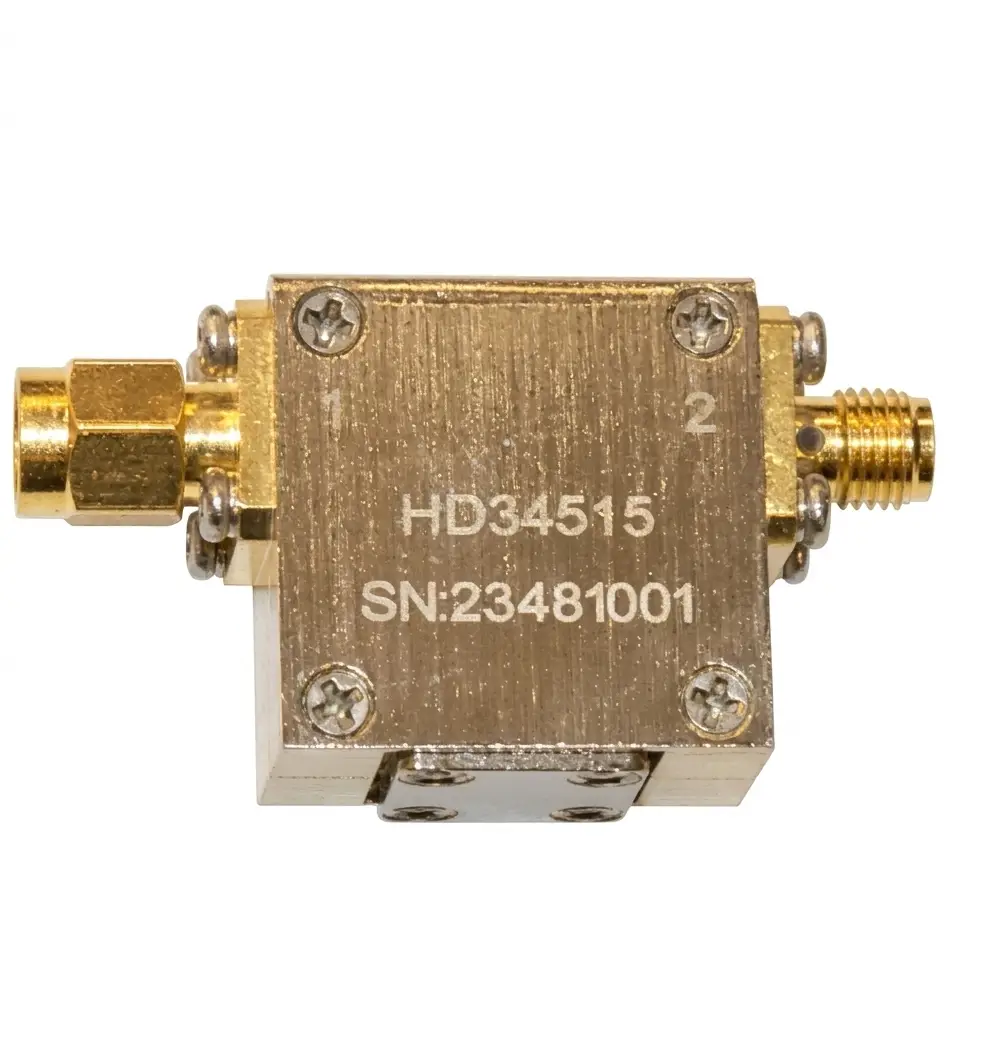
Isolators
Pass RF signals forward while attenuating reverse-traveling signals.
Connectorized Band Pass Filters
Pass a selected frequency band and attenuate signals outside it.
Connectorized Band Stop Filters
Attenuate a selected frequency band while passing frequencies outside it.
Connectorized Low Pass Filters
Pass lower frequencies and attenuate signals above the cutoff region.
Connectorized High Pass Pass Filters
Pass higher frequencies and attenuate signals below the cutoff region.
Low Pass/High Pass GaAs MMIC Filters
GaAs MMIC filters for low-pass or high-pass frequency selection.
Saw Band Pass Filters
Surface acoustic wave filters that select a frequency band.
Equalizers (GaAs MMIC)
Shape frequency response to compensate for signal-path gain variation.
Multiplexer/Diplexer
Combine or separate signal paths by frequency band.
Band Pass Filters
Pass a selected frequency band and attenuate signals outside it.
High Power Absorptive Filters
Filter unwanted frequencies and dissipate rejected energy.
Passive Frequency Doublers (1.25 \times 1.25 \times 0.63)
Passive components that generate a higher-frequency output from an input signal.
Passive Frequency Doublers (0.72 \times 0.66 \times 0.32)
Passive components that generate a higher-frequency output from an input signal.
Active Frequency Triplers (Narrow Band)
Generate a higher-frequency output from an input signal.
Active Frequency Triplers (Wide Band)
Generate a higher-frequency output from an input signal.
Active Frequency Multiply by 5 (Narrow Band)
Generate a higher-frequency output from an input signal.
Frequency Divider/Prescaler Up to 50 MHz
Divide an input frequency to produce a lower-frequency output.
Frequency Divider/Prescaler 4 GHz
Divide an input frequency to produce a lower-frequency output.
Frequency Divider/Prescaler 6 GHz
Divide an input frequency to produce a lower-frequency output.
Frequency Divider/Prescaler 8 GHz
Divide an input frequency to produce a lower-frequency output.
Frequency Divider/Prescaler 13 GHz
Divide an input frequency to produce a lower-frequency output.
Frequency Divider/Prescaler 15 GHz
Divide an input frequency to produce a lower-frequency output.
Frequency Divider/Prescaler 26 GHz
Divide an input frequency to produce a lower-frequency output.
Mixers (1.25 \times 1.25 \times 0.63)
Translate RF signals between frequencies using a local oscillator.
Mixers (0.96 \times 0.66 \times 0.32)
Translate RF signals between frequencies using a local oscillator.
Temperature Compensated Crystal Oscillator (TCXO)
Crystal oscillators with temperature compensation.
Oven Controlled Crystal Oscillator (OCXO)
Crystal oscillators using temperature-controlled ovens.
RF Adaptors
Connect RF interfaces with different connector configurations.
RF Connectors
Connector interfaces for RF signal paths.
RF Cable Assemblies
Cable assemblies for connecting RF components and equipment.
Waveguide to Coax Adaptors
Transition between waveguide and coaxial RF interfaces.
Coax Switches
Route RF signals between coaxial signal paths.
Low Power Pin Diode Switches
Use PIN diodes to switch RF signal paths.
High Power Pin Diode Switches
Use PIN diodes to switch RF signal paths.
VCOs (Connectorized)
Connectorized oscillators with voltage-controlled output frequency.
VCOs (High Performance)
Oscillators with output frequency controlled by a tuning voltage.
Antenna
Transmit or receive electromagnetic signals.
Block Down Converters
Translate a band of RF signals to a lower frequency range.
Diode Detectors
Convert an RF signal into an electrical output for detection.
Directional Coupler
Sample a portion of RF power from a transmission path.
Power Dividers
Divide an RF input signal among multiple output paths.
Rotary Joints
Transfer RF signals between stationary and rotating sections.
Terminations
Provide a terminating load for an RF signal path.
Waveguide Antenna
Transmit or receive signals through a waveguide-based antenna structure.
LIMITERS
Limit RF signal levels to help protect downstream components.
180° Hybrids
Split or combine RF signals with a defined phase relationship.
Directional Couplers
Sample a portion of RF power from a transmission path.
Coaxial Combiners
Combine RF signal paths through coaxial connections.
90° Hybrids
Split or combine RF signals with a defined phase relationship.
Digital Power Meters
Measure and display RF signal power.
Absorptive Filters
Filter unwanted frequencies and dissipate rejected energy.
Combiners Radial / E-plane
Combine multiple RF signal paths.