
Insights: Top RF Components for Microwave Systems in 2026
Top RF Components Powering 2026 High-Performance Microwave Systems
Modern RF solutions and microwave solutions are the backbone of next-generation technologies—from 5G RF components and satellite communication RF to radar RF systems and IoT RF modules. As systems push deeper into millimeter wave technology and demand high frequency RF solutions, the importance of selecting the right RF components has never been greater.
High-performance microwave systems are no longer just about transmitting signals—they must ensure RF signal integrity, minimize insertion loss RF, maintain optimal VSWR RF components, and support complex RF system integration. Engineers today must balance RF power levels, RF bandwidth solutions, and RF noise figure while designing systems that operate reliably across extreme environments.
Since 1976, RF engineers have relied on trusted RF solutions providers like RFComp to deliver custom RF solutions, microwave components, and RF engineering services tailored for aerospace, defense, telecom, and industrial applications. The challenge in 2026 is not just availability—but choosing the right combination of components that ensure performance, scalability, and future readiness.
This guide breaks down the top RF components every high performance microwave system requires—helping engineers, procurement teams, and system designers make informed decisions grounded in technical accuracy, performance optimization, and real-world application demands.
Powering Signal Strength and System Performance
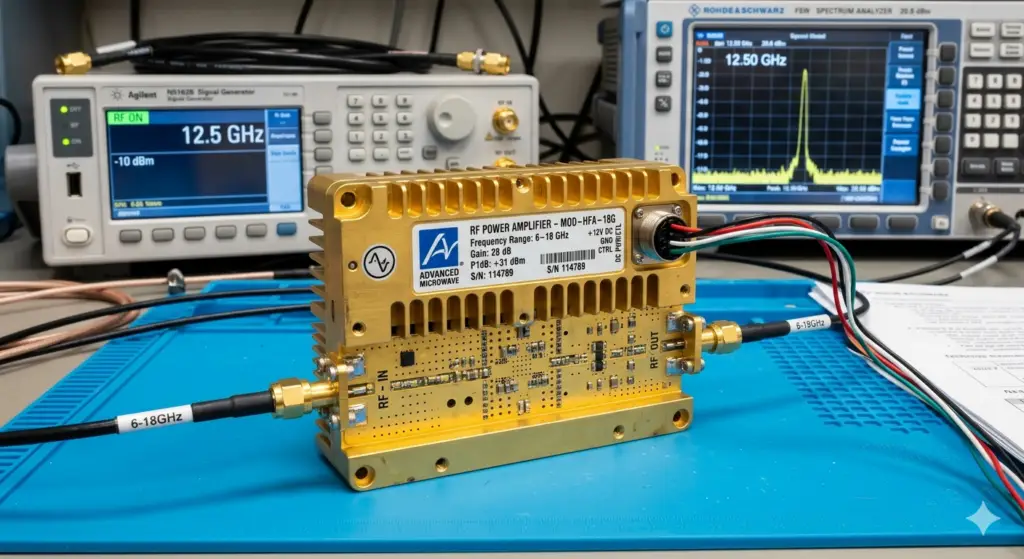
At the core of every high performance microwave system are RF amplifiers and microwave amplifiers, which directly impact signal strength, range, and clarity. These components are responsible for boosting weak signals in receivers and delivering sufficient output power for transmission in applications like aerospace RF systems, defense RF solutions, and telecom RF solutions.
Low-noise amplifiers (LNAs) are critical in maintaining a low RF noise figure, especially in satellite communication RF and wireless communication RF systems where weak signals must be preserved. Meanwhile, power amplifiers (PAs) are essential for achieving high RF power levels in radar RF systems and broadcast RF systems. Advanced technologies such as Gallium Nitride (GaN) are now enabling high power RF components with improved efficiency and thermal performance.
Modern amplifier design must also consider RF signal integrity and impedance matching RF, as mismatches can lead to signal reflections and degraded performance. According to industry insights, amplifier modules today can operate across wide frequency ranges (e.g., 2–18 GHz) with stable gain and low distortion, making them suitable for broadband RF solutions and RF frequency range solutions.
RF Amplifiers: Powering Signal Strength and System Performance
At the core of every high performance microwave system are RF amplifiers and microwave amplifiers, which directly impact signal strength, range, and clarity. These components are responsible for boosting weak signals in receivers and delivering sufficient output power for transmission in applications like aerospace RF systems, defense RF solutions, and telecom RF solutions.
Low-noise amplifiers (LNAs) are critical in maintaining a low RF noise figure, especially in satellite communication RF and wireless communication RF systems where weak signals must be preserved. Meanwhile, power amplifiers (PAs) are essential for achieving high RF power levels in radar RF systems and broadcast RF systems. Advanced technologies such as Gallium Nitride (GaN) are now enabling high power RF components with improved efficiency and thermal performance.
Modern amplifier design must also consider RF signal integrity and impedance matching RF, as mismatches can lead to signal reflections and degraded performance. According to industry insights, amplifier modules today can operate across wide frequency ranges (e.g., 2–18 GHz) with stable gain and low distortion, making them suitable for broadband RF solutions and RF frequency range solutions.
Ensuring Signal Purity and Interference Control
RF filters and microwave filters are essential for maintaining signal clarity by eliminating unwanted frequencies and reducing interference. In complex RF systems, especially those used in 5G RF components, automotive radar RF, and medical RF devices, filters ensure that only the desired signals pass through while blocking noise and interference.
Filters operate across the RF frequency spectrum and are designed to manage signal attenuation RF, optimize return loss RF, and maintain stable RF bandwidth solutions. They are fundamental in duplexers and multiplexers, which allow systems to transmit and receive signals simultaneously without interference.
Waveguide filters, often used in microwave systems, provide low-loss performance at high frequencies and are widely deployed in satellite communication RF and broadcast RF systems. These filters are particularly valuable in mmWave components where signal degradation is more pronounced due to shorter wavelengths and higher frequencies.
For engineers, selecting the right filter involves balancing insertion loss RF, RF impedance, and environmental considerations. Poor filter design can lead to signal distortion, reduced efficiency, and compliance issues in regulated industries like aerospace and defense.
RF Mixers, Oscillators, and Signal Generators
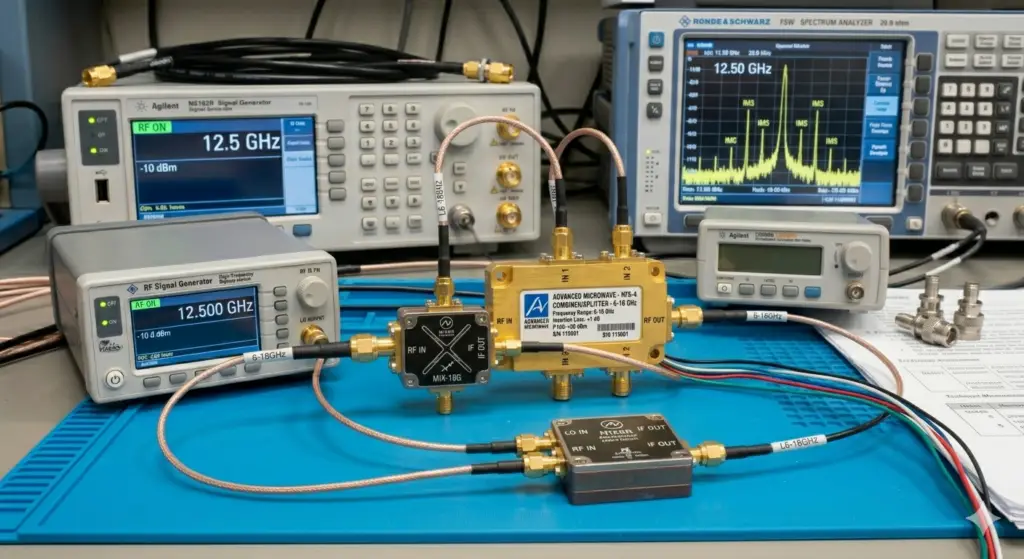
Frequency control is a defining requirement in advanced microwave solutions, and this is achieved through RF mixers, RF oscillators, and RF signal generators. These components are critical in converting signals between frequency bands—a process essential for wireless communication RF, radar RF systems, and RF edge computing.
RF mixers enable upconversion and downconversion, allowing signals to move between baseband and RF frequencies. This functionality is vital in RF system integration and microwave circuit design, where systems must operate across multiple bands.
RF oscillators provide stable frequency references, forming the backbone of timing in RF technology and microwave technology. In high-performance environments, phase noise and stability are critical factors that influence overall system accuracy.
Meanwhile, RF signal generators are indispensable in testing and calibration, supporting RF testing services, RF calibration services, and RF prototyping services. These tools ensure that systems meet performance specifications before deployment.
In 2026, with the rise of 5G mmWave solutions and RF solutions for AI infrastructure, frequency agility and precision are becoming even more important. Engineers must design systems capable of handling dynamic frequency environments while maintaining consistent performance.

RF Mixers, Oscillators, and Signal Generators
Frequency control is a defining requirement in advanced microwave solutions, and this is achieved through RF mixers, RF oscillators, and RF signal generators. These components are critical in converting signals between frequency bands—a process essential for wireless communication RF, radar RF systems, and RF edge computing.
RF mixers enable upconversion and downconversion, allowing signals to move between baseband and RF frequencies. This functionality is vital in RF system integration and microwave circuit design, where systems must operate across multiple bands.
RF oscillators provide stable frequency references, forming the backbone of timing in RF technology and microwave technology. In high-performance environments, phase noise and stability are critical factors that influence overall system accuracy.
Meanwhile, RF signal generators are indispensable in testing and calibration, supporting RF testing services, RF calibration services, and RF prototyping services. These tools ensure that systems meet performance specifications before deployment.
In 2026, with the rise of 5G mmWave solutions and RF solutions for AI infrastructure, frequency agility and precision are becoming even more important. Engineers must design systems capable of handling dynamic frequency environments while maintaining consistent performance.
Attenuators, Couplers, and Power Dividers
Passive components such as RF attenuators, RF power dividers, and RF couplers play a critical role in managing signal flow and ensuring system stability. While they do not amplify signals, they are essential for maintaining RF signal integrity and optimizing performance across high frequency RF solutions.
RF attenuators are used to control signal levels, preventing overload and protecting sensitive components. They are particularly useful in RF testing services and calibration environments.
RF power dividers split signals into multiple paths, enabling multi-channel communication in telecom RF solutions and IoT RF modules. Similarly, RF couplers allow engineers to sample signals without interrupting the main transmission path—critical for monitoring and diagnostics.
These components also contribute to maintaining proper VSWR RF components and RF impedance, reducing reflections and ensuring efficient power transfer. In high-performance systems, even minor inefficiencies in passive components can lead to significant performance degradation.
In modern RF engineering, passive components must be carefully selected based on frequency range, power handling, and environmental conditions to ensure long-term reliability and compliance with industry standards.
RF Switches, Connectors, and System Integration Components
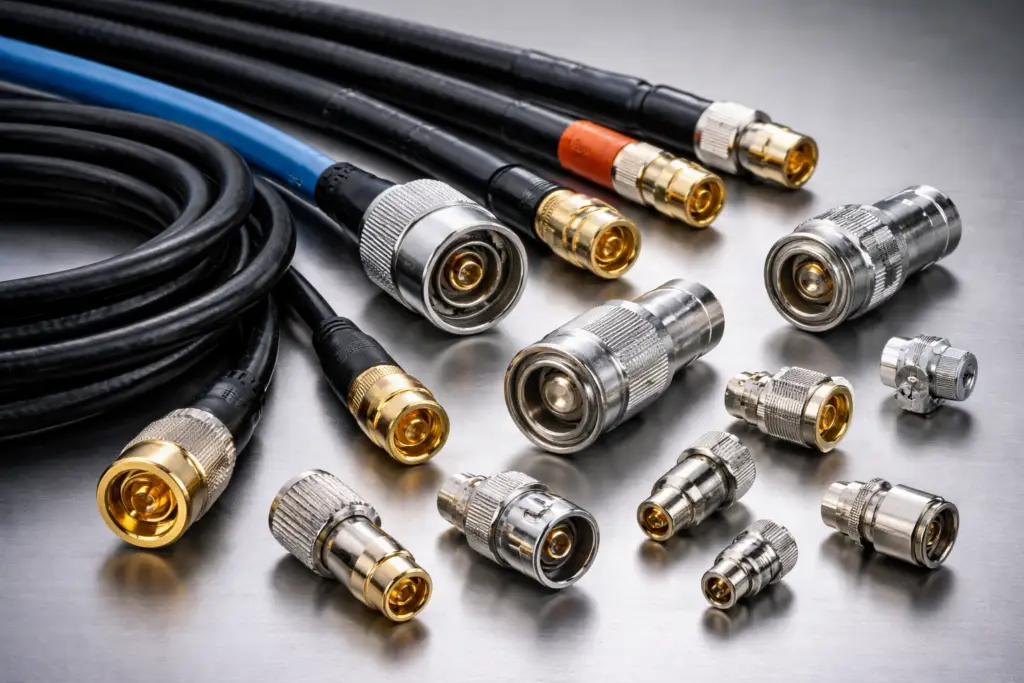
The final layer of a robust microwave system lies in RF switches, RF connectors, coaxial RF connectors, RF cables, and RF adapters—components that enable seamless connectivity and system flexibility.
RF switches are essential for routing signals between different paths, enabling reconfigurable architectures in radar RF systems, military microwave components, and smart city RF technology. They are also used in RF switch matrices, which allow complex signal routing in testing and communication systems.
RF connectors and microwave cables ensure low-loss signal transmission, which is critical in maintaining RF signal integrity across long distances. Poor-quality connectors can introduce unwanted reflections, increasing return loss RF and reducing system efficiency.
Additionally, RF system integration requires careful consideration of RF PCB design, impedance matching RF, and RF tuning solutions. The integration phase is where all components must work together seamlessly to deliver high performance microwave systems.
As next-gen RF technology continues to evolve, modular and scalable integration strategies are becoming essential—especially for RF solutions for robotics, autonomous systems, and data centers.
RF Switches, Connectors, and System Integration Components
The final layer of a robust microwave system lies in RF switches, RF connectors, coaxial RF connectors, RF cables, and RF adapters—components that enable seamless connectivity and system flexibility.
RF switches are essential for routing signals between different paths, enabling reconfigurable architectures in radar RF systems, military microwave components, and smart city RF technology. They are also used in RF switch matrices, which allow complex signal routing in testing and communication systems.
RF connectors and microwave cables ensure low-loss signal transmission, which is critical in maintaining RF signal integrity across long distances. Poor-quality connectors can introduce unwanted reflections, increasing return loss RF and reducing system efficiency.
Additionally, RF system integration requires careful consideration of RF PCB design, impedance matching RF, and RF tuning solutions. The integration phase is where all components must work together seamlessly to deliver high performance microwave systems.
As next-gen RF technology continues to evolve, modular and scalable integration strategies are becoming essential—especially for RF solutions for robotics, autonomous systems, and data centers.
Conclusion
Building a high performance microwave system in 2026 requires more than just assembling components—it demands a strategic approach to RF engineering, component selection, and system integration. From RF amplifiers and microwave filters to RF mixers, passive components, and connectivity solutions, each element plays a critical role in ensuring performance, reliability, and scalability.
As industries like aerospace, defense, telecommunications, and IoT continue to evolve, the demand for advanced microwave solutions and custom RF solutions will only grow. Engineers must prioritize RF signal integrity, RF power management, and broadband RF solutions to stay competitive in an increasingly complex landscape.
Partnering with an experienced RF solutions provider ensures access to high-quality components, expert guidance, and tailored solutions that meet exact specifications.
Looking to optimize your RF systems or source high-quality microwave components? Visit RFComp.com to explore a full range of RF components, request custom RF solutions, and connect with experienced engineers who understand your application requirements. Whether you’re designing for 5G, aerospace, or industrial RF applications, RFComp delivers precision at every frequency.
Tagged 5G RF components, advanced microwave solutions, broadband RF solutions, high frequency RF solutions, microwave components, microwave engineering, millimeter wave technology, RF amplifiers, RF design services, RF engineering, RF filters, RF signal integrity, RF solutions, RF systems, RF testing services, wireless communication RF